
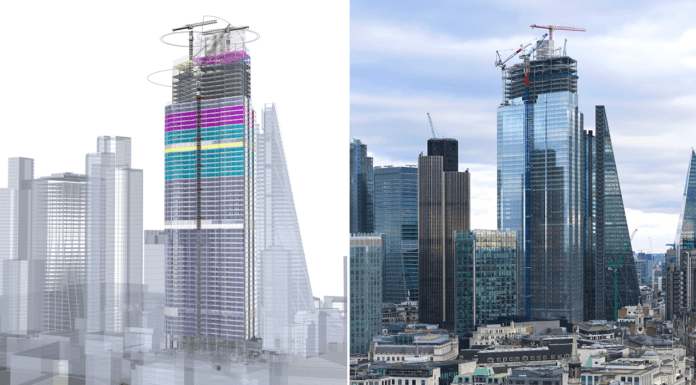
Major construction projects are getting harder to deliver. Programmes are more compressed, scopes are larger and more complex, the risk profile is harsher and clients expect fewer surprises. In that reality, how teams plan and work together becomes decisive, writes James Bowles
Planning is often mis-understood. It isn’t the act of producing a Gantt chart. It is the wider process of preparing the work, checking the logic and making sure the team understands and agrees the sequence. On every successful project I’ve seen, planning becomes a shared activity, not a technical exercise done in isolation.
Traditional planning has arguably reached its limit. Gantt charts and siloed workflows don’t keep pace with modern complexity. They often fail to show spatial clashes, temporary works interactions or logistics constraints. They’re usually owned by a small group of specialists, leaving everyone else to interpret a plan they didn’t help shape. The results are predictable. Misalignment, late discovery of issues, reactive decisions on site and steady drift away from predictable delivery.
Older methods relied on intermittent reviews. And when information is fragmented and siloed, teams spend too much time comparing and interpreting documents rather than discussing how the job should actually be built.
The industry delivered major projects this way for decades. Through sheer effort and strong site teams. But the process itself was inefficient. Temporary works became more complicated than necessary. Trades clashed. Productivity was lost in rework and last-minute fixes.
The strongest projects now take a different approach. Leadership sets the planning culture early. Programme, logistics, temporary works and methods are developed together, not separately.
Disciplines still produce their own information, but the value comes from joint review and shared ownership. Plus, teamwork is key, when everyone feels free to challenge assumptions, ask questions, and test ideas, issues appear earlier and delivery becomes more predictable.
A comment from a planner I worked with on past projects, Chris Needham, shows this clearly. In a review meeting, a contractor asked: “What does your programme say?” Chris replied: “It’s not my programme. It’s our programme. We need to build it and own it together.” Shared models support this mindset. One plan. Visible to all. Owned by the team.
4D modelling: From interpretation to problem-solving
This shift towards team planning has been accelerated by the rise of 4D modelling. Early 4D efforts were one-directional and mainly for presentations. One-shot animations created usually too late to have impact. Helpful, but limited.
Today, on many major projects, the 4D model has become the hub where engineers, managers, temporary works teams and supervisors review the plan together.
Once information is shown visually and in context, the conversation moves from interpretation to practical problem-solving. It’s perhaps similar to the old master-builder, where design, sequencing, methods and temporary works were understood as one combined process. The difference now is scale and clarity.
A moment on a Crossrail project 15 years ago confirmed all of this for me. We were reviewing a sequence for a deep excavation with ring beams and temporary props. The site manager had invited the tower crane driver and excavator operator to join.
During the review, the excavator operator asked to zoom in to the 4D model, on a tight working area between props. He pointed out that although the machine could physically do the work, the digging cycle would be slow, skip placement limited and crane utilisation terrible. We hadn’t seen the problem in the programme. A later detailed check showed it would have added weeks, if not months.
His insight took seconds because the model made the constraints obvious. His summary was blunt: “You can lower the machine into that space, but I’ll be in there for weeks digging it out. It’s not an excavation job. It’s a tunnelling job. Much slower.”
Modern projects demand modern planning
4D exposes the gaps that Gantt charts hide. It shows when trades collide, when logistics don’t fit, when temporary works obstruct the sequence and when assumptions break
down. These issues appear early, when fixes are simple and cheap. The model lets teams rehearse the job in detail and agree on a sequence that actually works. This turns planning from a reactive process into a proactive one.
Planning reviews become about shaping the work, not arguing over documents. Teams can interrogate the sequence visually. They can adjust methods, test alternatives and understand where constraints will appear. The plan becomes a shared asset rather than a schedule produced by one person and distributed to everyone else.
This way of working has real outcomes. Projects experience fewer surprises, fewer clashes and fewer periods of lost productivity. Temporary works become simpler and safer. Logistics become cleaner and more efficient. Time, cost and safety all improve because the team is aligned and working off a plan they understand and trust.
The point is straightforward. Modern projects demand modern planning. Not software alone. A shift in how planning is done. A team activity done early, based on clarity, open challenge and continuous review. The tools simply make that possible at the scale required today.
The post Collaboration, teamwork and 4D model construction appeared first on Planning, Building & Construction Today.