
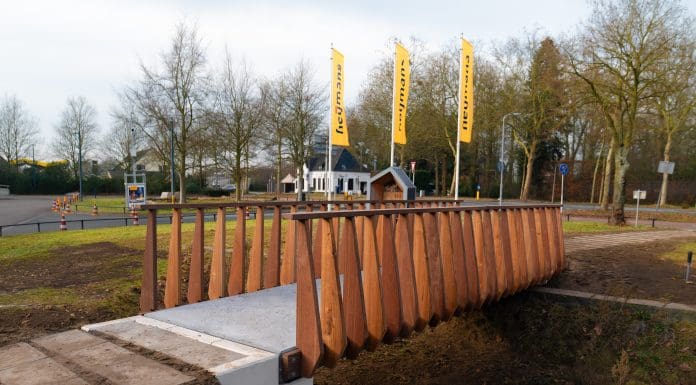
Paebbl and Heijmans have unveiled a ‘world first’ showcase of a 7 metre, CO₂-neutral concrete pedestrian bridge, containing 75% circular raw materials, with no primary sand or gravel
Dutch construction company Heijmans and climate tech company Paebbl have achieved what “was previously considered impossible in structural construction”, a fully CO₂-neutral concrete bridge, using Paebbl’s carbon-storing material with biochar and recycled aggregates.
The concrete easily achieved its strength requirements, demonstrating that sustainability does not compromise with structural performance.
Sequestering carbon will play a significant role in reducing overall emissions
Cement accounts for 8% of global carbon emissions, highlighting the urgent need for innovations in the construction sector. Paebbl’s material offers dual benefits: the first is permanent CO₂ storage, with the capacity to sequester up to 300 kg of CO₂ for every 1,000 kg produced. The second is a significant reduction in embodied carbon, with their materials serving as a partial cement replacement and slashing embodied carbon in construction by up to 30%.
The bridge deck permanently sequesters almost 66 kg of CO₂ with Paebbl Materials.
By accelerating natural mineralisation processes by a factor of a million, Paebbl locks CO₂ into stable mineral form instead of emitting it. This approach allows construction projects to embed carbon within building materials, transforming the built environment from a large emitter into a potential carbon sink.
Carbon neutral structural concrete is ‘achievable today’
Nick Vervoort, innovation manager at Heijmans, commented: “This bridge proves that carbon-neutral structural concrete is not a future aspiration, it’s achievable today. For the first time, CO₂-neutral concrete has been poured using an innovative mix of materials: Paebbl, biochar and recycled concrete. This demonstrates what collaboration and ambition can achieve. We’re very proud that the concrete mix used in this bridge is fully CO₂-neutral and contains 75% circular raw materials.”
Ana Luisa Vaz, VP of Products at Paebbl, adds: “A 30% cement replacement rate in structural concrete is our highest to date. This demonstration pedestrian bridge demonstrates that carbon-storing materials aren’t just viable for decorative or non-structural uses, they’re ready for real infrastructure.”
The project brought together a consortium of sustainability pioneers: Heijmans provided project leadership and construction expertise; HCM Cement supplied the optimised cement formulation; Van der Kamp B.V. managed concrete production; CarStorCon® Technologies contributed biochar integration; and Urban Mine provided recycled aggregates.
The post World’s first bridge made with CO₂-neutral concrete revealed appeared first on Planning, Building & Construction Today.