
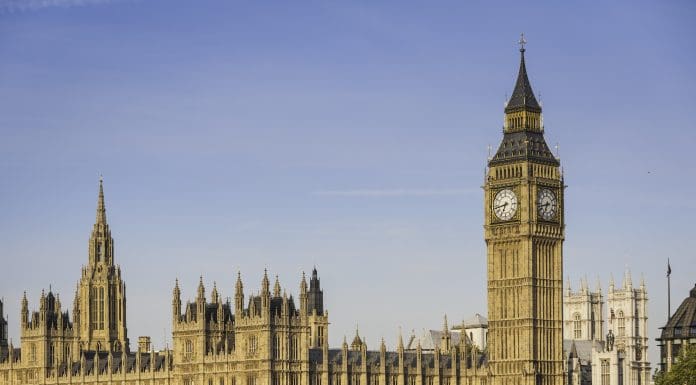
The Restoration and Renewal (R&R) Client Board has published a report advising MPs to begin work to restore the Houses of Parliament this year
The £3bn parliament restoration could begin this year, if recommendations are taken to heart.
The Houses of Parliament have long been considered to be in a state of disrepair, meaning a restoration project would be welcomed by many.
The project would take place in phases
The initial phase of the project would see temporary office and chamber spaces erected to allow work to continue, as well as a new river jetty to take in and remove construction material. The programme for the project will also be developed, as three different options have been decided on.
Procurement would also begin this year, with strategic plans to be appointed by 2027.
The three options as listed in the R&R’s summary are:
- Full decant: where both Houses move out of the Palace of Westminster for the majority of the works;
- Continued presence: where the House of Lords would move out for the duration of the main works and the Commons Chamber and its essential support functions (for example key procedural services) would remain in the Palace of Westminster. We recommend that this option should not be further developed because its challenges—including the extended decant periods for both Chambers— outweigh its benefits compared with the other delivery options; and
- Enhanced maintenance and improvement (EMI): under which broadly not more than 30% of the Palace of Westminster (by usable area) would be decanted at any one time. The Palace of Westminster would be split into 14 zones which would be worked on in stages: functions of both Houses would be decanted for periods to facilitate this. Two variants of the EMI option have been assessed:
- EMI: this variant had the ambition of seeking to retain both Chambers in place throughout the Programme, with any work on the Chambers taking place in recesses and out-of-hours. The variant is set out in this report but following a recommendation by the Programme Board we recommend that it should not be further developed. It would have had a high cost together with the longest duration of any option; and
- EMI+: under this variant, the House of Lords would be decanted for 8 to 13 years while the Commons, subject to the Lords’ agreement, would be decanted to the Lords Chamber for up to two years.
“It is difficult to consider such questions”
The call to action at the end of the report reads: “As custodians of this national landmark we recognise that the sums involved in protecting it weigh heavily and that it is difficult to consider such questions at a time of economic challenge and global uncertainty. We also recognise the difficulty in committing upfront, as envisaged by the 2019 Act, to a specific amount of expenditure totalling many billions of pounds to deliver an option which will take multiple Parliaments to complete. We are therefore recommending a way forward which allows substantial progress to be made, while offering the Houses the ability to direct and oversee the Programme as it develops, in line with the recent best practice from major programmes.”
“We propose that the Houses should be invited to agree to an initial package of works, defined as “phase one works”. The works would include up to seven years expenditure as well as financial commitment for completion of significant works, such as underground works, that cannot be stopped immediately at the end of the seven year period. The Houses would be asked to commit to expenditure in support of the works in this phase one package. It is currently estimated that the package would cost up to £3bn, or £429m a year on average (both figures excluding inflation).”
The report can be read in full here.
The post R&R Client Board recommend beginning of £3bn parliament restoration appeared first on Planning, Building & Construction Today.