
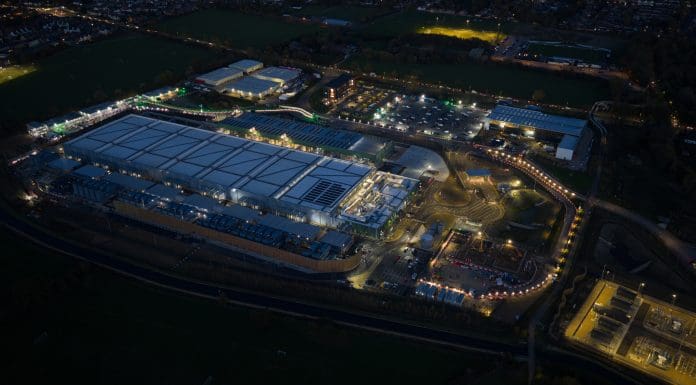
The £100bn data centre boom risks building AI capacity that can’t perform, writes Matt Salter of Onnec
Calls to slow the UK’s data-centre boom are getting louder. In Scotland, MSPs have been urged to pause new AI data centre development, while elsewhere concerns over energy, water and local impact have fuelled calls for a wider moratorium.
But the build-out is not stopping for now. Andy Burnham recently rejected calls for a moratorium and more than £100bn of data centre construction is now planned in the UK.
For the construction industry, that creates an obvious opportunity. But is the industry so focused on getting new capacity built that it’s not spending enough time making sure it will work as intended?
With data centres already under intense public scrutiny, the facilities being built need to justify the land, energy, materials and money going into them by delivering the performance they were designed for. If they require disruptive and expensive remediation soon after go-live, that makes the commercial and sustainability case much harder to defend.
Speed is already changing decisions
Onnec’s research of 300 senior data-centre decision-makers across the UK, Ireland and the Nordics found that 65% had seen demand for AI capacity increase over the previous 12 months.
That is putting huge pressure on operators and construction teams to move faster. Programmes are being compressed, specifications are changing late and decisions are increasingly being made against fixed deadlines rather than with the luxury of long planning cycles.
The danger is that short-term decisions made to protect the programme can create much longer-term problems once a facility is live. That might mean designing around what the first deployment needs rather than what the next one will require, accepting what can be sourced quickly or reducing the time available for testing and documentation.
On a conventional project, those decisions may be manageable. In an AI data centre, where rack densities and network demands are changing quickly, they can become expensive problems surprisingly fast.
Cabling can make or break an AI data centre
Cabling does not get the same attention as power, cooling or GPUs. But none of those assets delivers its full value if the network connecting them cannot support the workload.
That is where operators are starting to feel the strain. Our research found that 77% believe cabling is becoming a critical bottleneck in their ability to support AI workloads, while 41% say it always or frequently delays AI capacity projects.
The challenge is not simply installing more cable. AI environments are denser, hotter and harder to design around, with heat and power density constraining routes, alongside skills shortages, supply-chain pressure and rapidly changing hardware requirements.
Under that pressure, 78% of operators say they have compromised on cabling quality or specification to deploy AI faster. The consequences are already showing up after go-live: 37% have experienced bottlenecks affecting AI training, 33% have been unable to scale without significant additional cabling work and 31% have seen high-performance AI hardware investment wasted because the cabling could not support it.
For construction teams, these are more than “IT problems” that can be solved at the end of the job. By the time rack layouts, containment, power and cooling routes are fixed, the options for connectivity may already have narrowed.
Design for change, not just go-live
The answer is not to slow projects down but to make better decisions before the design is fixed. Cabling, compute, power and cooling need to be planned as one system from the start, not brought together late in the programme.
That means involving connectivity specialists while layouts and pathways can still be influenced and designing for the next deployment rather than just the first. Teams may not know exactly what future GPUs will require but they can leave enough pathway capacity, access and flexibility to support higher density and bandwidth.
It also means protecting time for testing and documentation, so faults are easier to trace and future upgrades are less disruptive. And where availability forces a compromise on products or contractors, teams need to understand what that decision means for performance, resilience and future expansion.
A cable can be replaced relatively easily. An undersized pathway or a poor design decision is much harder to undo once the facility is live.
Building fast is only half the job
The UK is likely going to keep building data centres. The construction industry now has to make sure the facilities being delivered are not just completed on time but capable of supporting the AI workloads driving the boom in the first place.
That matters even more while the sector is under scrutiny over land, energy, water and community impact. If billions are being invested and significant resources committed, new facilities need to deliver the value they were built for without requiring costly fixes soon after opening.
The real test is whether the infrastructure still works when demand increases, hardware changes and the next generation of AI arrives.
The post AI data centres are going up fast – but can they deliver? appeared first on Planning, Building & Construction Today.
