
Here Craig Abbott, technical director of FSi Promat – part of the Etex group, looks at the challenges around fire stopping in retrofit projects and best practice solutions to ensure compliance
Retrofit has become a key focus in construction as the industry faces new regulations and is challenged to support decarbonisation and cost-efficient growth. However, in bringing buildings back into use, upgrading properties, or changing their use, it is essential that up-to-date safety is a priority – especially life-critical products such as fire stopping.
With the Government’s commitment to reach net zero by 2050 – and 25% of carbon emissions being generated by the built environment – retrofit projects will be pivotal in supporting a reduction in carbon emissions. In addition, buildings are increasingly being updated to reduce energy emissions, with commercial non-domestic buildings required to meet EPC B by 2030.
Many of these projects will see substantial changes that will impact the passive fire protection systems installed. It is vital that these are factored into retrofit designs and specifications, and that installers and sub-contractors are aware of the need to reinstate fire resistant compartments using appropriate fire stopping where a breach or alteration has been made.
Compliance
Any building work must be carried out in line with the current Building Regulations, including retrofit projects, which means that fire stopping as part of a passive fire protection system must meet the requirements of Approved Document B and ensure an appropriate seal is installed. This is essential to maintaining compartmentation, such as along wall joints and around service penetrations, to stop the spread of fire and smoke for a set period of time.
In addition, retrofit projects must meet the requirements of the Building Safety Act, which, in the case of passive fire protection, will require accurate specification, backed by comprehensive testing and performance data, at the earliest stage to allow progress through the gateway system.
Common challenges
Unlike a new build project, where a passive fire protection system should be specified at the design stage and any service penetrations identified within that, retrofit projects may require a greater degree of flexibility and consideration.
In a heritage project, the installation of passive fire protection systems can be complex and may require a fire engineer to factor in immovable elements of the building design. For listed buildings, it is essential to carry out work without damaging the fabric of the building, and it is not uncommon to find ageing systems hidden behind piecemeal upgrades in historic buildings that have put pipework out of reach. This may require additional work to access these systems to allow them to be adequately fire stopped.
In addition, the age of the pipework may be a factor that could affect standard sizing around apertures and spacing.
Access can be a considerable issue in refurbishment projects, with often only one side of an application being accessible, due to either the physical location of the seal or to avoid the costly displacement of residents if the building is occupied.
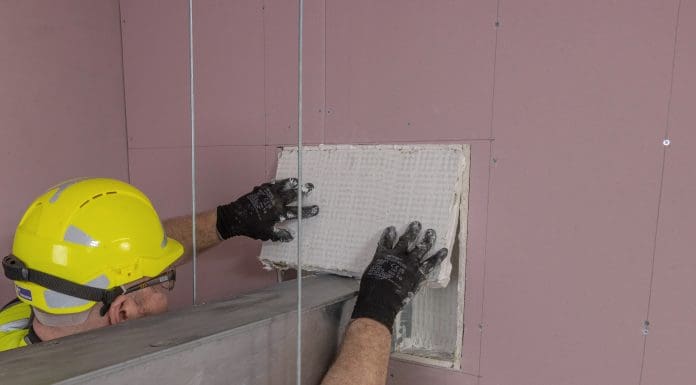
As a recognised problem, specific solutions have been created to accommodate this, with fire stopping systems now available for a single-sided application. FSi Promat has tested its Stopseal Batt system in conjunction with Pyrocoustic Sealant, HPE Sealant, PipeBloc PCP Collars and EL Wrap systems in various single-sided configurations, which allows a compliant seal to be put in place to reinstate compartmentation without the need for access to both sides of the wall.
Accurate specification
It is vital that buildings being retrofitted for a change of use have the correct specification of passive fire protection. Multiple occupancy buildings demand the highest level of passive fire protection to ensure the occupants have time to escape in the event of a fire – and that the integrity of the building is protected to allow firefighters access in the event of a fire. The switch to a residential property is likely to see the time resistance of passive fire protection increase, and any change of use must incorporate the level of fire protection specified in its fire strategy document.
Whatever the scale of the project, it is essential that any changes to services, such as pipes and cabling, and to windows, doors and air vents, as well as to the fabric of the building, take into account the need to reinstate compartmentation through adequate fire stopping.
Fire stopping is required for all service penetrations where compartmentation is in place, which means that any upgraded services will need to be adequately fire stopped to ensure compartmentation remains intact. The same applies to any alterations to fire doors, windows or façades, and any additional breaches onto the compartment walls to facilitate access.
“…retrofit projects must meet the requirements of the Building Safety Act, which, in the case of passive fire protection, will require accurate specification, backed by comprehensive testing and performance data, at the earliest stage to allow progress through the gateway system.“
This is further complicated in retrofit projects by the element of the unknown as to what passive fire product has been used previously, and when it was installed. If there is no record of the installation, the fire stopping will need to be replaced to ensure that the passive fire protection in the building is compliant.
Further to this, mixing existing, older passive fire protection with new is prohibited due to evidence not being available to clearly demonstrate the installation and product details, meaning that the tested solution for fire stopping in that application cannot be supported, as the full details cannot be verified.
Working around occupants
Another major challenge around retrofit projects is working in a building that is already occupied. Accurate planning and clear communication are essential to minimise disruption – raising awareness of the work that is taking place and that it will enhance safety.
The single-sided fire stopping systems from FSi Promat bring a huge benefit to both residents and contractors, as there is no need for them to vacate properties during the works, causing minimal disturbance and avoiding high displacement costs.
The need for change to support a better future through delivering more sustainable sustainable solutions in the built environment is clear – and making use of existing building stock is going to play a key part in that. We do, however, need to keep in sight the need to balance safety with sustainability.
The post Out with the old, in with the new: Compliant fire stopping for retrofit projects appeared first on Planning, Building & Construction Today.