

Property and facility managers face greater challenges than ever before. How can technology help and what is holding them back?
How do you foster innovation in the world’s oldest asset class? This is a question that has challenged proptech companies for many years. The commercial real estate sector, despite its immense value and global importance, often proves resistant to change and technological advancement.
To gain a better understanding of the real estate industry’s attitude towards data and technology, we commissioned Censuswide, one of the world’s most respected market research consultancies, to conduct a survey of 452 asset managers and heads of innovation at industrial and logistic, office and retail real estate companies with at least $500m in assets under management in Germany, the United Kingdom and the United States.
In an era of increased digitisation across industries and throughout the world, the data collected by the survey revealed a surprising lack of digital resources in the commercial real estate sector. Perhaps most concerning, however, is the seeming lack of awareness in some of the responses that these circumstances exist.
This is clearly illustrated by the fact that, across asset classes and geographies, 73% of respondents agreed with the statement that the technology they use for building management is “state-of-the-art”.
That assertion is contradicted by a number of other data points in the survey. For example, nearly half (49%) of all respondents said they collect data manually and usually manage it in spreadsheets – led by office building operators with 53%.
Meanwhile, among all respondents, 23% said their data is stored in several, unconnected software solutions, while only 5% said they link data on a special platform or with a special solution.
That last data point, that only 5% of respondents use a dedicated platform or solution for data, is particularly revealing (and concerning). In an era when connected platforms are commonplace in many other industries and there are also specific ones for the real estate industry, why aren’t more property and facility managers utilising these platforms?
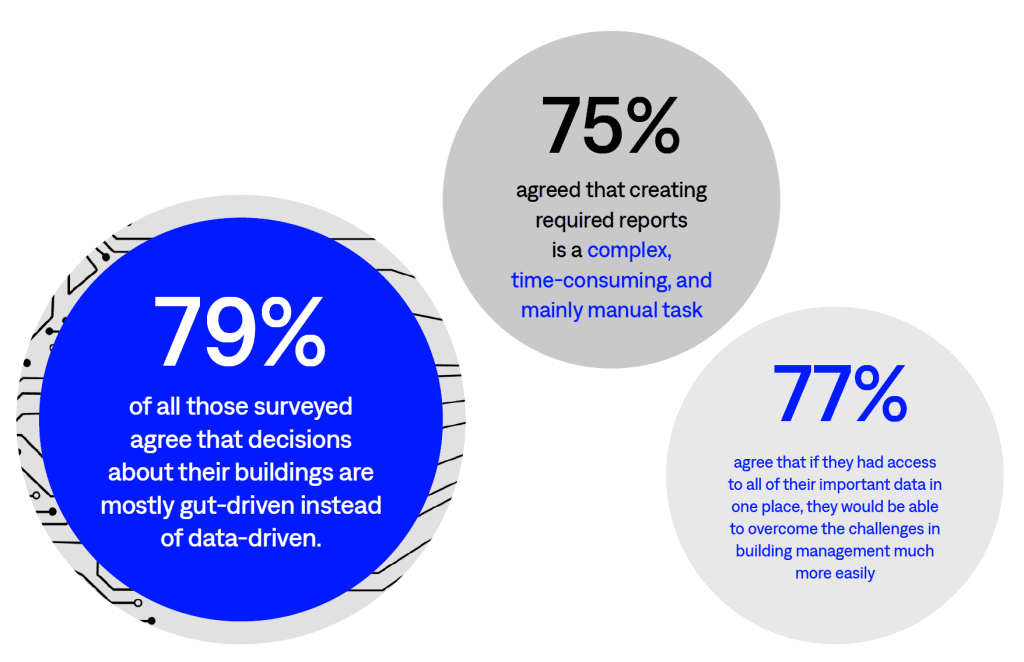
Therefore, it is not surprising that 79% of all those surveyed agree that decisions about their buildings are mostly gut-driven instead of data-driven. Commercial real estate has long been viewed, in some respects, as an industry that favours the qualitative over the quantitative, but in an era of such robust data it seems potentially irresponsible, or at least misguided, to render decisions via such an overwhelmingly gut-oriented method.
Moreover, these data issues seem to be notably contributing to the labour burden that respondents referenced earlier in the survey. 75% of all respondents agreed that creating required reports is a complex, time-consuming and mainly manual task, while 77% agree that if they had access to all of their important data in one place, they would be able to overcome the challenges in building management much more easily.
Even for those respondents who store data electronically and know how to find it, there are limitations to the value they can derive from it. Across asset classes and geographies, 37% of respondents said they need expert knowledge to understand the data they have, while the same number said that their data is mostly outdated.
In addition, 35% of all respondents agree that they have an overload of useless data, while 35% say they have very limited data and 34% assert that most of their data is unused.
Additional responses from the survey further support the notion of a data gap. For example, 77% of respondents said they constantly needed insight into the real-time performance of their buildings and 79% say there needs to be a single repository for all important building data.
Based on these responses, it is possible to draw some key conclusions. Commercial property managers and heads of innovation are:
Overburdened in terms of their workload.
- Either lack access to data digitally, have data stored in too many disparate systems or lack the tools/expertise to parse their data.
- Believe that their workload could be substantially reduced if they had improved data/data access and other digital solutions.
And yet, the majority of respondents still believe they are working with state-of-the art technology. This suggests either a lack of awareness about the increasingly broad spectrum of tools that exist or a resistance to implementing them.
Some of these themes place a burden on proptech companies: to do a better job at communicating the solutions that exist; to provide better training to customers once they’ve acquired a product or platform, so that they are leveraging its full potential; to design more holistic solutions.
But there are also lessons to be learned for real estate companies based on this data. Primarily: as technology evolves and becomes increasingly important to the real estate sector, employing individuals dedicated to understanding and acquiring new tools is essential.
Because an industry where nearly 80% of professionals are making decisions based on their gut instinct rather than data is surely going to face challenges in an increasingly data-oriented world. In other words, the world’s oldest asset class will have to evolve, whether it wants to or not.
Download the full report here: 
*Please note that this is a commercial profile.
The post Rewiring the real estate sector: The industry report appeared first on Planning, Building & Construction Today.