
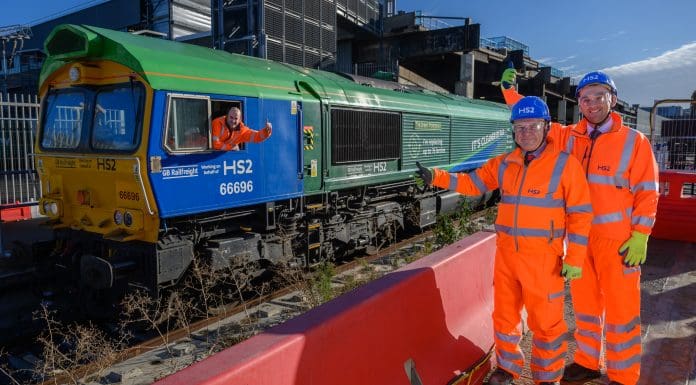
HS2 is using rail freight to remove 170,000 tonnes of excavated material from Euston, avoiding more than 10,000 HGV journeys on London’s roads
On Monday (16 November), Rail Minister Lord Hendy visited the site to see how the operation is supporting construction of the new HS2 station.
The bulk excavation is now underway, with the site being dug to around seven metres to make way for the new platforms. Material is being transported by train from a new loading facility alongside Euston’s disused Track 17 to Forders Sidings in Bedfordshire, where it will be reused at the Stewartby Brickworks development.
Successful trials between February and September 2026 moved around 35,000 tonnes of material. A further 135,000 tonnes is expected to be transported over the next ten months, with up to two trains a day operated by GB Railfreight. Each train can carry around 715 tonnes – equivalent to approximately 45 HGVs.
Rail minister, Lord Hendy said: “Moving this soil by rail will mean thousands fewer HGV journeys through the streets around Euston, helping to reduce disruption for local people, improve road safety and cut carbon emissions.
“This is part of the real progress we are making on HS2. All 23 miles of the tunnels between Old Oak Common and Birmingham have now been dug, and more than 80% of the project’s major structures are under construction or complete. Under new leadership, HS2 Ltd is delivering more for every pound, having moved 20 million cubic metres of earth – 16% ahead of plan.”
Cutting carbon emissions
The programme has been developed with Network Rail and industry partners to ensure freight services can operate alongside passenger trains. Using rail freight also reduces carbon emissions, producing up to 76% fewer CO₂ emissions than road transport for the same load and distance.
Andy Swift, stations delivery director, HS2 said: “We are committed to reducing the impact of our work on the communities around Euston. Moving material by rail is one of the most effective ways we can reduce the number of construction vehicles using local roads.
“Delivering this programme has required careful planning with Network Rail, GB Railfreight and our construction partners. That collaboration will allow us to move up to 170,000 tonnes of material by rail while passenger services continue to operate at Euston.”
The initiative builds on HS2’s wider use of rail freight to support construction, reduce road traffic and limit disruption to local communities. The Track 17 facility is expected to remain available until early 2029, with further opportunities being explored to support construction across the wider Euston campus.
Patrick Cawley, director for On Network Works at Network Rail and HS2, said: “We’re proud to be working with HS2 and our rail industry partners to help make this programme possible. It’s been a real collaborative effort across many different teams to safely accommodate these freight trains alongside the day-to-day operation of one of Britain’s busiest stations, while keeping passengers moving.
“It’s also a great example of what the railway can do best. Moving more materials by rail means fewer lorries on local roads and lower carbon emissions, and we’re pleased that the existing railway is playing such an important role in supporting the delivery of HS2 at Euston.”
The post HS2 rail freight to remove 170,000 tonnes of excavated material from Euston appeared first on Planning, Building & Construction Today.