
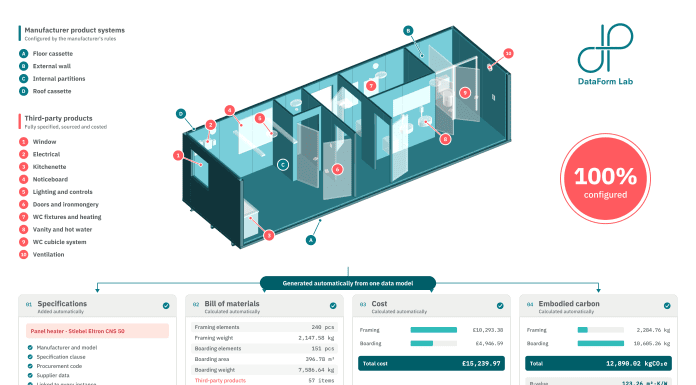
DataForm Platform generates volumetric modules that are 100% configured and costed, and carries that information through to the factory floor
Volumetric construction makes a bold promise: that entire rooms, apartments or data halls can be manufactured, finished and tested in the factory, then craned into place ready for use. Of all offsite methods, it moves the most value offsite. It also concentrates the most complexity. A single module brings together floor, wall and roof systems, structural connections, building services, windows and doors, finishes and furniture, each of which must be coordinated, specified, costed and sequenced for production.
Yet the digital tools available to volumetric manufacturers were largely shaped by panelised construction. They automate the structure and stop at the production drawing. Everything that turns a structural box into a finished module is resolved elsewhere: in spreadsheets, supplier catalogues, client correspondence and the experience of individual engineers.
This is the completion gap, and it is where much of Volumetric’s promised productivity is lost. Closing it requires a different starting point: treating the finished module, not its frame, as the product. That is the principle behind the DataForm Platform, which generates volumetric modules that are 100% configured and costed, and carries that information through to the factory floor.
Productisation is about rules, not repetition
Volumetric manufacturers face a familiar dilemma. Productisation is essential to factory efficiency yet every site, client and brief demands something different. Too often, the choice has been between rigid standard products and costly bespoke engineering.
The more useful distinction is between standardising outcomes and standardising rules. The DataForm Platform encodes a manufacturer’s design and manufacturing rules so design variability is fully supported rather than merely tolerated.
Modules are saved as reusable templates in a library of proven products. Variations of a product system can be applied instantly, reconfiguring floor, wall and roof products and applying the correct detailing between them. Openings, internal layouts and fitout remain editable, and every change is validated against the same rules.
In that way, variation stops being a threat to manufacturability and becomes a managed feature of the product.
A module is not finished until its fitout is
If the finished module is the product, the fitout cannot sit outside the configuration. In most cases, volumetric modules must arrive on site complete, and the fitout carries a substantial share of their cost, risk and client scrutiny.
Within the DataForm Platform, MEP fixtures and equipment, windows, doors and furniture are all part of the module. Crucially, they are not just geometry. Each third-party product is a complete entity linked to its specification, procurement codes and supplier data, so project specifications, third-party bills of materials and cost calculations are generated automatically. General arrangement drawings showing every fitout element are exported for both manufacturing and client approval.
This also changes how manufacturers serve different clients. Rather than duplicating design options whenever a customer wants something slightly different, users apply client presets. The product remains the same; only the information layer changes, keeping data manageable and design libraries lean.
From products to buildings
The same logic scales from module to building. Modules pulled from the library combine into multi-module configurations, bringing all their data with them, so quantities, specifications and costs for the whole building are calculated instantly. Product families and systems can be swapped across the building to meet client requirements without re-engineering each module. Commercial answers arrive at the pace of the design conversation, not after a lengthy estimating exercise.
Where variability meets the factory floor
From a manufacturing perspective, though, variability that is valuable to clients becomes complexity in production. Even slight differences between modules make resources hard to schedule, create bottlenecks and force planners to readjust schedules repeatedly, sometimes several times a day. This is the hidden cost of flexibility, and it is rarely visible when a project is sold.
That cost can now be managed at source because every module in the DataForm Platform carries its full configuration data. The platform generates optimised production schedules based on the design variability of each module, allocates resources accordingly and produces detailed task lists for every operator.
Planners can anticipate when, and how many, subcontractors will be needed, balancing in-house and subcontracted labour in advance according to demand and the pre-manufactured value (PMV) of each project.
Engineering bills of materials (EBOM) are converted automatically into manufacturing bills of materials (MBOM), so each process step receives correctly sequenced information and exact material lists.
Completeness as a competitive advantage
The next productivity gains in volumetric manufacturing will not come from producing drawings faster. They will come from connecting every decision that defines a module, from product rules and fitout to cost, scheduling and labour, into one continuous process.
That is what the DataForm Platform makes possible. Configuration, specification, costing, building assembly, production planning and manufacturing information share a single data model, so a decision made in the module library flows directly to the cost plan, the operator’s task list and the materials at each workstation. For the first time, a volumetric module can move from its first configuration to execution on the factory floor without a single break in information.
The result is not just fewer engineering hours per project but fully costed offers, client changes absorbed without disruption, and factories planned around the real content of each module. Volumetric construction has always promised a finished product. The digital tools behind it should deliver the same.
Please note: This is a commecial profile
The post Beyond production drawings: Configuring volumetric modules that leave the factory complete appeared first on Planning, Building & Construction Today.