
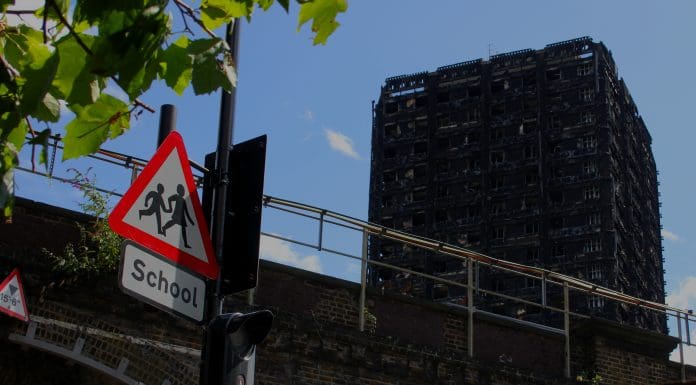
The devastating ‘chimney effect’ that contributed to the rapid spread of smoke and fire at London’s Grenfell Tower in 2017 is being tackled by a research project between specialists at the University of Hertfordshire and construction firm Ambar Kelly
By working together, Herts and Ambar Kelly plan to tackle one of the construction industry’s most overlooked safety problems: the chimney effect. This happens when hot gases, fire, and smoke rise rapidly through vertical shafts in a building, spreading upwards, downwards, and horizontally.
Scientists from the University’s School of Physics, Engineering, and Computer Science (SPECS) will provide expertise in thermodynamic analysis and simulation, structural design, heat transfer modelling, and optimised fire safety materials and engineering for riser shafts.
Ambar Kelly will use this to improve their range of industry-leading fire safety products for risers in multi-storey buildings.
Dr Antonis Kanellopoulos, director of the Centre for Engineering Research at the University of Hertfordshire, said: “This partnership will leverage Herts’ proven expertise in structural engineering, construction materials science, and thermofluids for commercial problem-solving.
“It provides a comprehensive and multidisciplinary approach that aims to deliver a product which will provide a step-change in managing fire hazards within riser shafts.”
How the chimney effect causes fire dangers in high-rise buildings
In high-rise buildings, lift shafts, stairwells, service risers, cladding cavities and ductwork can act like chimneys if they are not properly sealed, maintained, compartmentalised and fire-stopped.
Every multi-storey building contains at least one riser, a vertical shaft for essential building services.
Fire safety engineers and expert witnesses for the Grenfell Tower Inquiry examined fire routes and the impact of construction material combustibility on smoke and flame spread, identifying combustible materials around columns as a key factor in rapid fire spread.
“Currently, fire safety in riser shafts is poorly understood. The Grenfell Tower fire tragedy led to the removal of combustible cladding, but riser shafts remain overlooked, despite their role in vertical fire spread,” stated Alex Bardett, managing director of Ambar Kelly.
Structural testing at elevated temperatures
Dr Kanellopoulos and his team use state-of-the-art facilities, including a high-performance computing cluster for advanced thermodynamic simulations, materials characterisation equipment and facilities for structural testing at elevated temperatures.
Bardett explained: “This project will significantly advance fire safety in high-rise buildings by addressing critical gaps in current regulations. Ambar Kelly will gain advanced expertise in fire behaviour within riser shafts, particularly the ‘chimney effect’, influencing building safety standards.
“Through this approach, we will embed advanced fire simulation, materials, test and manufacturing capabilities, leading to growth for ourselves and the local economy, and it will also provide the industry with the skills, knowledge and products it needs to ensure that the conditions at Grenfell and elsewhere are never replicated again.”
The post Industry and academics partner to help overcome Grenfell ‘chimney effect’ appeared first on Planning, Building & Construction Today.