
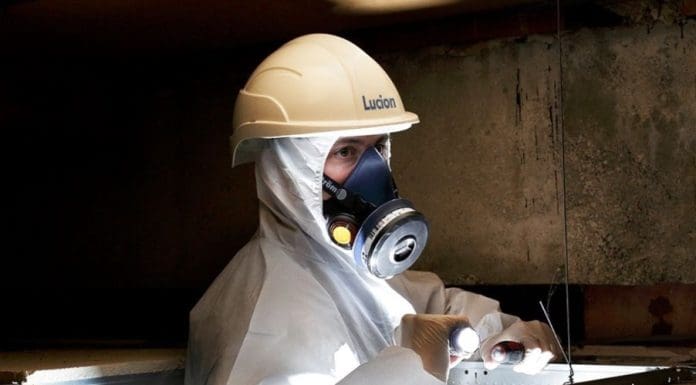
New changes to the UK’s asbestos regulations could initially lead to a rise in failed clearance assessments, according to Lucion Group
However, the company also believes this initial rise, driven by new asbestos regulations, could be a positive sign of improving standards across the industry.
Stuart Goodman, head of key accounts at Lucion Group, said: “When you are employed by the LARC, the pressure to hit deadlines and keep the project moving lands on you. Fine cleaning and the four-stage clearance (4SC) process are often given too little time in planning.”
“Separating the analyst from the contractor lets them work in the client’s best interests, without feeling pressured to pass a removal because the people paying the bill are watching. That should drive up quality and standards and improve confidence in the Certificates of Reoccupation. I wouldn’t be surprised to see a temporary rise in failed four-stage clearances at first, as analysts feel the pressure ease. That would be a sign the change is working.”
What will be changing under the new asbestos regulations?
The Health and Safety Executive (HSE) published its formal response to the consultation on the Control of Asbestos Regulations 2012 (CAR 2012) on 3 November 2026, confirming plans to amend Regulation 20 to remove potential conflicts of interest in the four-stage clearance process.
The changes will prevent licensed asbestos removal contractors (LARCs) from appointing the analysts responsible for assessing whether an area has been properly cleaned and is suitable for reoccupation following licensed asbestos removal work.
Supported by 71% of consultation respondents, the changes have been welcomed as an important step towards greater independence and accountability in asbestos management.
The HSE says the Statutory Instrument comes into force on 24 November 2026, with a 12-month transition period before enforcement begins in November 2027.
No mandatory UKAS accreditation has sparked debate
However, while the move towards independent clearance has been welcomed, the HSE’s decision not to introduce mandatory UKAS accreditation for asbestos surveying organisations has also prompted debate across the sector.
Despite 52% of consultation respondents supporting mandatory accreditation and just 29% opposing it, the HSE has opted to retain its existing approach of strongly recommending that duty holders use accredited surveying organisations.
Goodman explained: “I’m an advocate for accredited surveying companies. I understand the counterarguments, and the responses were right to stress that survey quality depends on the competence, experience and judgement of individual surveyors.
“But I work for a company that is audited for the best part of three weeks every year to maintain its accreditation. That gave clients extra peace of mind.”
Industry should review existing arrangements and plan ahead
The consultation, which received 358 responses, also confirmed that the Notifiable Non-Licensed Work (NNLW) category will be retained, with the HSE committing to clearer guidance to help businesses understand when asbestos work falls within this classification.
With the changes to independent clearance scheduled for November 2027, Lucion Group is encouraging duty holders, property managers and project teams to review their existing arrangements and consider the potential implications for project planning.
Goodman concluded: “My advice for clients and project managers would be to allow enough time for the four-stage clearance (4SC) process so that no corners are cut. Engage your asbestos consultant early. It helps set realistic timelines and avoids unexpected delays later in the programme.”
The post New asbestos regulations could lead to rise in failed clearance assessments appeared first on Planning, Building & Construction Today.