
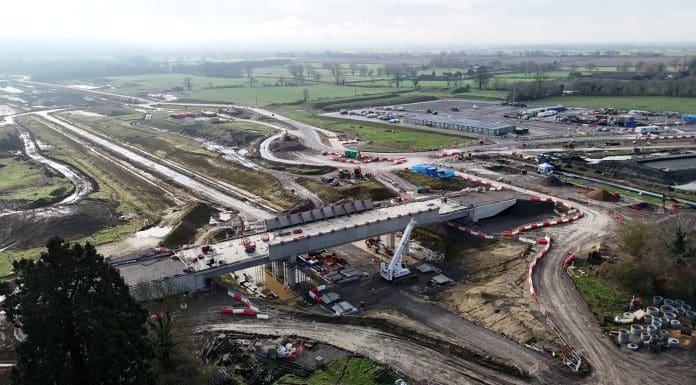
Making Britain’s infrastructure more resilient requires us to look beyond individual assets. That means strengthening railways, protecting roads, maintaining water networks and improving the reliability of the power grid while designing each asset as part of a connected system, writes Nathan Marsh, senior vice-president and regional executive, EMEA at Bentley Systems
Infrastructure does not work in isolation. Transport, water, power and communications networks depend on one another, so pressure on one can disrupt the others and affect the systems, communities and businesses rely on every day. The task is therefore to plan, build and operate infrastructure as an interconnected system, with these dependencies clearly understood.
Infrastructure is one connected system
Extreme weather is one example that brings these interdependencies into sharp focus. As we have seen time and again in recent years, heat, water scarcity, flooding and other pressures rarely stay within one sector: water constraints can disrupt energy and industry, while power outages can quickly affect transport and communications. Because the systems supporting society are connected, disruption in one can quickly cascade through the rest.
Looking at each sector independently obscures where pressure in one area could create consequences elsewhere. Resilience cannot be addressed sector by sector; it requires a holistic view of the networks and dependencies that bind our infrastructure together.
Individual assets remain critical. Roads, railways, water networks, power infrastructure and buildings still require maintenance, renewal and strengthening. But investment decisions should reflect how each asset depends on, and affects, the wider network.
Connected systems need connected information
The physical connections between infrastructure create a corresponding digital challenge.
Planning, design, construction and operations generate huge volumes of data. When those records remain fragmented across organisations, technologies and lifecycle stages, building a complete picture of an asset and its wider context becomes much harder.
Managing infrastructure as a connected physical system depends on linking the information that describes it. Engineering models, geospatial reality data, subsurface intelligence and operational records should provide a shared context for action. Together, these sources show professionals how an asset relates to its surroundings, how conditions are changing and where dependencies or vulnerabilities lie.
This connected context is also what makes AI useful for infrastructure. A model can only produce trustworthy, relevant options when it is grounded in the reality of the project: design intent, site conditions, engineering standards, construction changes and operational performance. Connecting those threads turns fragmented records into a durable body of knowledge that can support better decisions across the asset lifecycle.
Seeing problems before they cause disruption
Digital twins provide an important capability here. By combining data about assets and networks, they create the context needed to assess changing conditions and emerging risks, while giving AI a reliable foundation for analysis. Engineers and operators can use that shared view to track performance, detect developing stress, test potential responses and see how changes in one area could affect another.
That visibility enables owners and operators to assess evolving conditions, anticipate consequences and act before a problem becomes a failure.
AI can extend this visibility by analysing more variables and testing more scenarios than conventional workflows allow. But infrastructure decisions have physical consequences, so the use of AI must be governed by engineering judgement and grounded in project realities, standards and performance criteria. AI can generate and compare options at speed; engineers remain responsible for defining intent, navigating trade-offs and deciding what is safe and appropriate.
Infrastructure organisations should move from reactive maintenance to predictive resilience. Doing so requires them to identify vulnerabilities sooner, prioritise the interventions that matter most and assess potential knock-on effects before disruption spreads.
Think in systems from the start
Infrastructure projects must be designed, delivered and operated as dynamic, connected systems from the outset. Digitising individual processes is not enough if information and workflows remain trapped in traditional silos. Every stage from planning and design through construction and operation should preserve the connections needed to understand and manage the whole system.
Choices made during planning and design determine how effectively an asset can be understood, maintained and adapted throughout its life. Artificial intelligence can expand engineering capacity by helping teams evaluate more scenarios, detect patterns and optimise designs against multiple constraints. But those capabilities depend on trusted data and deep engineering context, while professional judgement remains essential when navigating trade-offs. AI should inform decisions, not become the objective itself.
Resilience means understanding the whole system
Britain will continue to need investment in roads, railways, water, energy, communications and the built environment. But strengthening individual assets is only part of the resilience challenge.
We must also account for how those assets interact: shifting from isolated assets to integrated networks, from fragmented data to shared context and from reacting to disruption to identifying vulnerabilities earlier.
Technology cannot prevent extreme heat, flooding, water scarcity or other pressures. It can, however, help those responsible for our infrastructure build the broader view needed to anticipate consequences and respond as conditions change.
Ultimately, resilience is not simply about making individual infrastructure assets stronger. It is about designing every asset as part of an integrated system, building with those connections in mind and operating with them front of mind. Infrastructure must function as a system if it is to navigate the changing demands of this decade and those to come.
*Please note, this is a commercial profile.
The post Resilience starts with seeing infrastructure as one connected system appeared first on Planning, Building & Construction Today.