
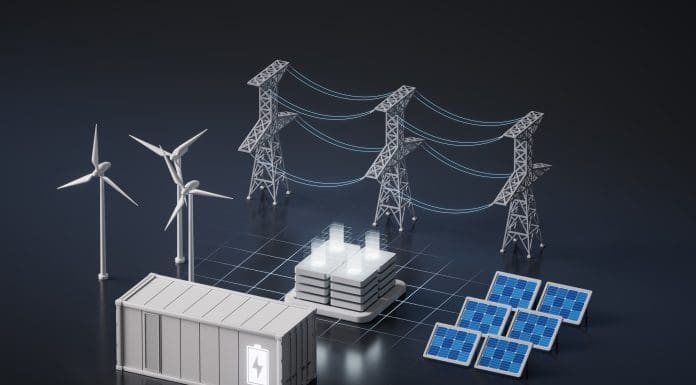
Tom Woolley, director of Metis at SMS, discusses the financial costs of implementing solar and battery infrastructure and how they can become affordable and accessible to everyone
Britain’s energy transition faces a fundamental challenge: how do we deliver a cleaner, more resilient energy system without placing the financial burden on households?
From electrifying transport and heating to overcoming grid constraints and retrofitting millions of homes, the required investment is significant.
The government’s latest Budget acknowledges this challenge, prioritising lower energy bills and delivering ‘good growth in every postcode’. The new Warm Homes Loan Scheme also seeks to address a major barrier to domestic solar and battery adoption: upfront costs.
These are welcome developments, but they raise a more fundamental question: Why are we still treating solar panels and batteries as consumer products when they are increasingly becoming essential energy infrastructure?
The consumer model cannot deliver at scale
For most households, installing solar panels and battery storage remains a significant financial decision.
Homeowners must choose a system and installer, find thousands of pounds in capital or arrange finance, and take responsibility for technology expected to operate for decades.
While this model works for some, it cannot be the only route to nationwide deployment.
Solar and storage must become part of Britain’s wider housing infrastructure, working alongside electric vehicle charging, heat pumps and smart controls to manage how electricity is generated, stored and consumed.
These technologies are no longer simply home improvements. They are becoming fundamental to how Britain’s energy system operates.
Breaking the upfront investment barrier
The UK’s energy transition cannot depend on households having thousands of pounds to invest upfront.
We don’t expect consumers to fund electricity substations or telecommunications networks, so why should the infrastructure needed to generate, store and manage energy at home be treated differently?
An alternative is to treat solar panels, battery storage and smart energy systems as long-term infrastructure assets, funded through investment and managed by specialist providers.
This would shift responsibility for installation, operation and maintenance away from individual households, while encouraging a longer-term focus on performance, reliability and efficiency.
Importantly, it would also remove a major financial barrier to adoption, helping to make clean energy technologies accessible at the scale required to support the UK’s energy transition.
Affordability requires more than access to borrowing
There has rightly been considerable discussion about making finance more accessible for households looking to invest in energy efficiency and low-carbon technologies.
However, we should not assume that the answer to an affordability problem is simply to make it easier for households to borrow money.
Government grants and backed lending have a role, particularly in tackling fuel poverty and supporting improvements that would otherwise be financially unviable.
However, public funding can also work alongside private investment.
If institutional capital can finance domestic energy infrastructure over its useful life, neither government nor individual households need to bear the entire upfront cost.
This could create a more scalable approach to deployment, allowing more households to access solar and storage while spreading infrastructure costs over a longer period.
The important consideration is whether these arrangements deliver genuine financial benefits for residents. Any model must be transparent about ongoing costs, maintenance responsibilities and expected savings, ensuring that affordability remains central to the proposition.
Turning Britain’s homes into a flexible energy network
The benefits of domestic solar and storage extend beyond individual properties.
A battery installed in one home helps a household use the electricity it generates more effectively. Thousands operating intelligently together become a distributed energy resource capable of responding to changing conditions across the electricity system.
Through virtual power plant arrangements, connected batteries can charge when electricity is abundant, reduce demand during peak periods and potentially provide flexibility services to the wider network.
As Britain becomes increasingly reliant on renewable generation, this flexibility will be important in managing fluctuations in supply and demand.
Crucially, infrastructure ownership need not remove consumer choice. Physical assets can be managed independently of household electricity supply arrangements.
Rethinking energy infrastructure in new developments
Grid connections are already a major consideration for new developments, while electrifying heating and transport will place further pressure on local electricity networks.
Yet solar panels and batteries are still often considered as individual technologies installed on individual properties.
Developers should instead explore how distributed generation, battery storage and intelligent demand management can form part of the infrastructure strategy for entire developments.
Where hundreds of homes can generate, store, and manage electricity as a coordinated system, there is potential to use available network capacity more efficiently and, depending on local conditions, help address connection constraints.
Considering these technologies earlier in the planning process could also strengthen coordination between developers, energy providers and infrastructure investors.
This is no longer simply about specifying energy-efficient homes. It is about planning the infrastructure that entire communities will depend on.
Retrofit cannot remain out of reach
Millions of British homes will need to transition towards cleaner, more efficient energy systems. Yet for many households, the biggest barrier to solar and battery storage remains the upfront cost.
In Oxfordshire, Metis, developed by SMS, is exploring an alternative approach with 302 households, providing solar panels, battery storage and smart energy management without requiring homeowners to purchase the infrastructure outright.
The programme is expected to deliver approximately £386,000 in gross energy savings, averaging £1,150 per household. After subscription costs, average net savings are projected to exceed £400.
While individual outcomes will vary, the programme demonstrates the potential for alternative financing and ownership models to make domestic energy infrastructure more accessible.
Similar approaches could help local authorities and housing providers accelerate retrofit programmes where budgets are constrained.
The next step for Britain’s energy transition
Britain has the technology to decarbonise its homes. The challenge is deploying it across millions of properties while improving affordability, energy security and grid flexibility.
Government grants, backed finance and private investment all have a role to play. But we must move beyond a model that relies on homeowners having the capital to invest.
Solar panels and batteries should not remain discretionary consumer luxuries available primarily to households with the means to purchase them.
They are becoming essential components of Britain’s energy infrastructure and should be financed, managed and deployed accordingly.
The success of Britain’s energy transition will depend not just on the technologies we deploy, but on whether we can make them affordable and accessible to everyone.
The post Solar and batteries are becoming essential infrastructure. It’s time we started treating them that way appeared first on Planning, Building & Construction Today.